A 15-Minute Daily Music Practice Routine Using Just Your iPhone
Fifteen minutes a day beats two hours once a week. Here is a four-block iPhone-only practice routine using tuner, metronome, and recorder — plus a weekly progression that actually compounds.
Almost every musician knows the trap. Practice is sporadic. The week gets busy. Saturday comes and you sit down for a long session to "make up for it" — except your hands feel stiff, the metronome feels punishing, and after 25 minutes you put the instrument back on the stand and tell yourself next week will be different.
The research has been clear for a while: short, daily practice beats long, weekly practice by a wide margin. Fifteen minutes every day will outperform two hours once a week, every time. The trick is removing the friction that stops you from sitting down.
In 2026 the friction-removal tool you already own is your iPhone. The tuner, metronome, recorder, and analyzer are all in one app. There is no setup. There is no excuse. Here is a four-block routine that fits the 15 minutes anyone can carve out of a day.
Why 15 minutes beats 2 hours
Skill acquisition runs on consolidation, not on raw hours. Your brain encodes motor patterns during sleep — not during the practice session itself. Seven 15-minute sessions across a week gives your brain seven consolidation cycles. One 2-hour session gives you one cycle, plus a lot of fatigue.
The other thing daily practice does: it kills the warm-up tax. When you only play once a week, the first 20 minutes are spent getting your hands to remember what they knew last Saturday. Daily, that warm-up tax shrinks to almost nothing — because your hands never really forget.
The 15-minute floor is also psychological. It is short enough that you cannot reasonably say "I do not have time." It is long enough that real progress accumulates. The goal is consistency, not heroics.
What you need (and what you do not)
You need: your instrument, your iPhone, and a quiet-ish place. Headphones help but are optional.
You do not need: a tuner pedal, a separate metronome, a recorder, a notebook, a music stand, or any subscriptions. The four core tools — tuner, metronome, recorder, chord/key analyzer — are all free in Larka. The whole routine works on the free tier.
The one thing worth setting up once: put a stand for your phone where you usually practice, ideally angled so you can see the metronome and tuner without picking the phone up. Reaching for the phone mid-practice is the single biggest source of distraction.
The 4-block routine: 3 + 3 + 5 + 4 minutes
Block 1 — Tune (3 min)
Block 2 — Metronome warmup (3 min)
Block 3 — One focused thing (5 min)
Block 4 — Record, listen, log (4 min)
Do these in order. The order matters. Tuning first means everything you play after is in tune. Metronome before focused work means your time is loaded before you spend it on something hard. The recording at the end gives you a permanent before-and-after across weeks.
Block 1 — Tune (3 min)
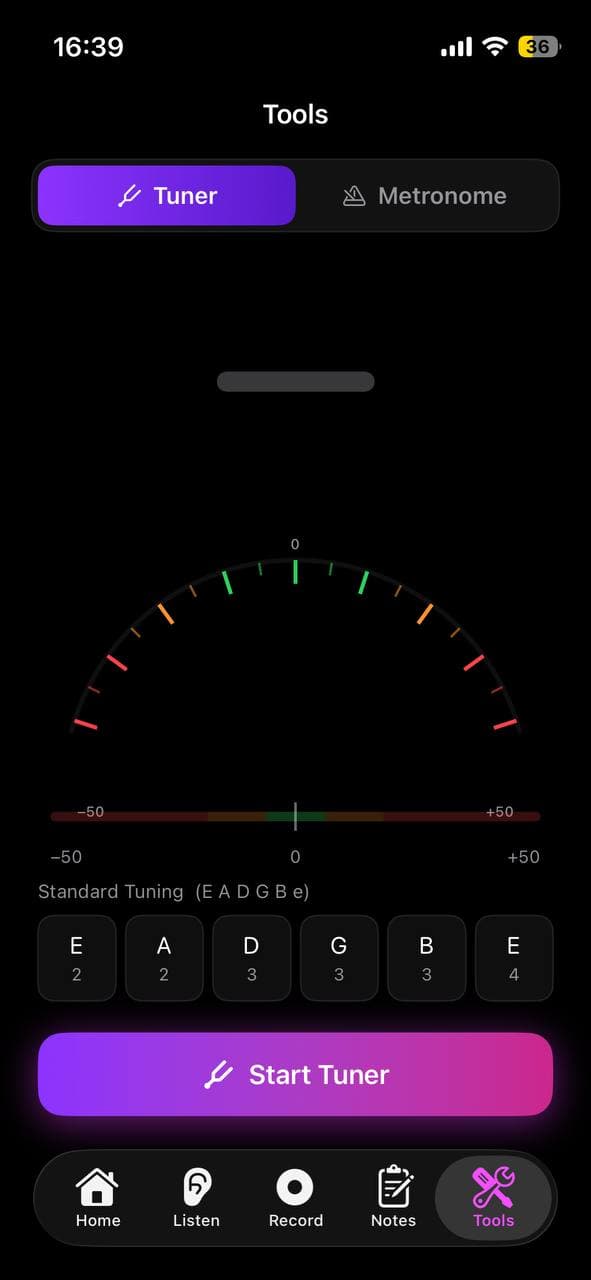
Open the Tuner. Play each open string slowly. Wait for the needle to settle. Adjust until the dot turns green.
Do this every session. Tuning is the cheapest thing you can do for your sound, and most musicians skip it on the assumption that "it sounded fine yesterday." Strings drift overnight from temperature changes alone. An out-of-tune instrument trains your ear to accept out-of-tune intervals.
If your instrument is already in tune (it happens), use the remaining time to play a slow chromatic scale — each note individually, checking the tuner. This trains pitch recognition and gives your fingers a methodical warm-up before the metronome arrives.
Block 2 — Metronome warmup (3 min)
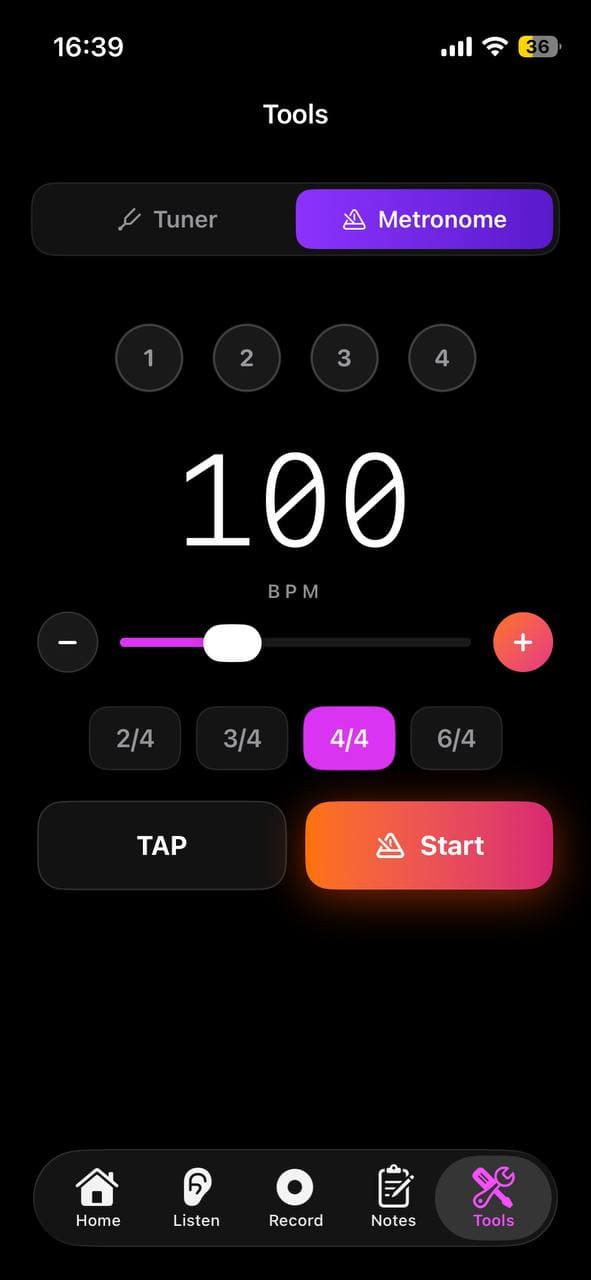
Open the Metronome. Set it to 60 BPM. Play one note per beat — just one note, any note in scale — for one minute. Then 80 BPM, one minute. Then 100 BPM, one minute.
This is not exciting. That is the point. The metronome warmup trains the only skill that almost no musician practices intentionally: locking your time to a click. Three minutes a day across a year is roughly 18 hours of pure time-feel practice. Most amateur musicians have done zero such hours in their lives.
If you already feel solid with one-note-per-beat, scale this up: two notes per beat at 60 BPM, then four notes per beat. The goal is not speed. The goal is for the click to disappear into your playing — not fight it.
Block 3 — One focused thing (5 min)
Pick one specific thing to work on. Not three. Not "general practice." One.
Good candidates: a chord transition that always trips you up, a phrase from a song you are learning, an arpeggio across the neck, a strumming pattern, a vocal interval. Keep the metronome going at a tempo where you can play the thing 75% accurately.
This block is where actual learning happens. The rule: if you can play it perfectly, you are not practicing — you are performing. Speed up the metronome until you are at the edge of your ability, then sit at that edge for the full five minutes. Mistakes here are good. Comfortable repetition here is wasted time.
Rotate the focus across the week. Monday — chord transitions. Tuesday — a song. Wednesday — a scale. Thursday — a song. Friday — ear training. The variety beats grinding the same thing for seven days.
Block 4 — Record, listen, log (4 min)
Open the Recorder. Record yourself playing the thing you just practiced — once, all the way through, no second takes. 60–90 seconds.
Stop the recording. Larka analyzes it automatically: detected key, BPM, chord progression. That metadata is your log.
Now listen back. Without your instrument in your hands. Headphones help. Listen for: timing drift, dynamics (are you loud and quiet, or all medium?), one specific mistake you keep making.
The insight from listening is almost never the same insight you had while playing. Your ears, freed from your hands, catch things your hands could not feel.
The remaining minute: rename the recording with one word about what you noticed ("rushed", "stiff thumb", "intonation", "good"). That one word is your practice journal. Stack a few weeks of them and patterns appear.
A weekly progression that actually works
Doing the same routine forever stagnates. A weekly arc keeps it alive:
Monday — Fundamentals. Block 3 = the most basic thing you can practice (chord changes, scale, posture).
Tuesday — Repertoire. Block 3 = a song you are learning.
Wednesday — Theory in motion. Block 3 = a chord progression from Larka’s Chord Detector run on a song you love. Play along.
Thursday — Repertoire. Same song as Tuesday — you will hear the difference 48 hours of sleep made.
Friday — Ear training. Block 3 = play a recording of a song, pause it, hum the next chord, then play it. Larka’s Listen Mode confirms the chord. Sharpens functional ear.
Saturday — Creative. Block 3 = improvise over a recording, or write a phrase, or hum into the Hum-to-Song flow and learn the chords back. No "correct" goal.
Sunday — Review. Listen back to the seven recordings from the week. Pick the one that surprised you. Re-listen. Decide what to focus on next week.
What this routine will not do
It will not turn you into a virtuoso. It will not replace lessons with a real teacher — a teacher catches things a phone never will, especially physical-form problems that hurt you in the long run.
It also will not make you good at any specific genre by itself. Daily fundamentals plus a separate, larger weekly session on the things you actually want to play (a band rehearsal, a long focused songwriting session, a teacher-led lesson) is the right combination.
What the routine *will* do: keep your hands warm, your ear sharp, your time tight, and your relationship with practice non-negotiable. Those four things are the foundation everything else gets built on. The 15 minutes a day is the floor. Whatever you do beyond it grows from there.
The deeper point
Musicianship is mostly the accumulated effect of small daily choices, not the dramatic effect of occasional big sessions. The reason most people never get as good as they hoped is not lack of talent — it is the slow erosion of a daily habit they could not protect.
A phone in your pocket is the closest thing to friction-free practice that has ever existed. The tuner is always there. The metronome is always there. The recorder is always there. The only thing left to remove is the part where you do not sit down.
Fifteen minutes. Tomorrow. Then the day after.
Be first to try Larka AI
Larka launches on iPhone and iPad soon. Join the waitlist for an early-access link the moment it's live.
Join the waitlist →